
Most firms think growth means one thing: hiring. More clients means more staff, more overhead, more training, and more risk if the hiring market stays tight. Firms using white-label accounting are proving that assumption wrong. They’re growing their client base without growing headcount by putting their name on work delivered by a specialized partner behind the scenes, without the client ever noticing a difference.
What White-Label Accounting Actually Means
White-label accounting means a firm outsources bookkeeping, tax prep, or reporting to a specialized partner using modern bookkeeping software for business, then delivers that work to clients under the firm’s own brand. The client never knows a third party touched the numbers. From their perspective, it’s simply their CPA firm delivering accurate, timely work. The firm keeps the relationship and the revenue while offloading the labor-intensive production behind it.
Why This Model Is Gaining Ground
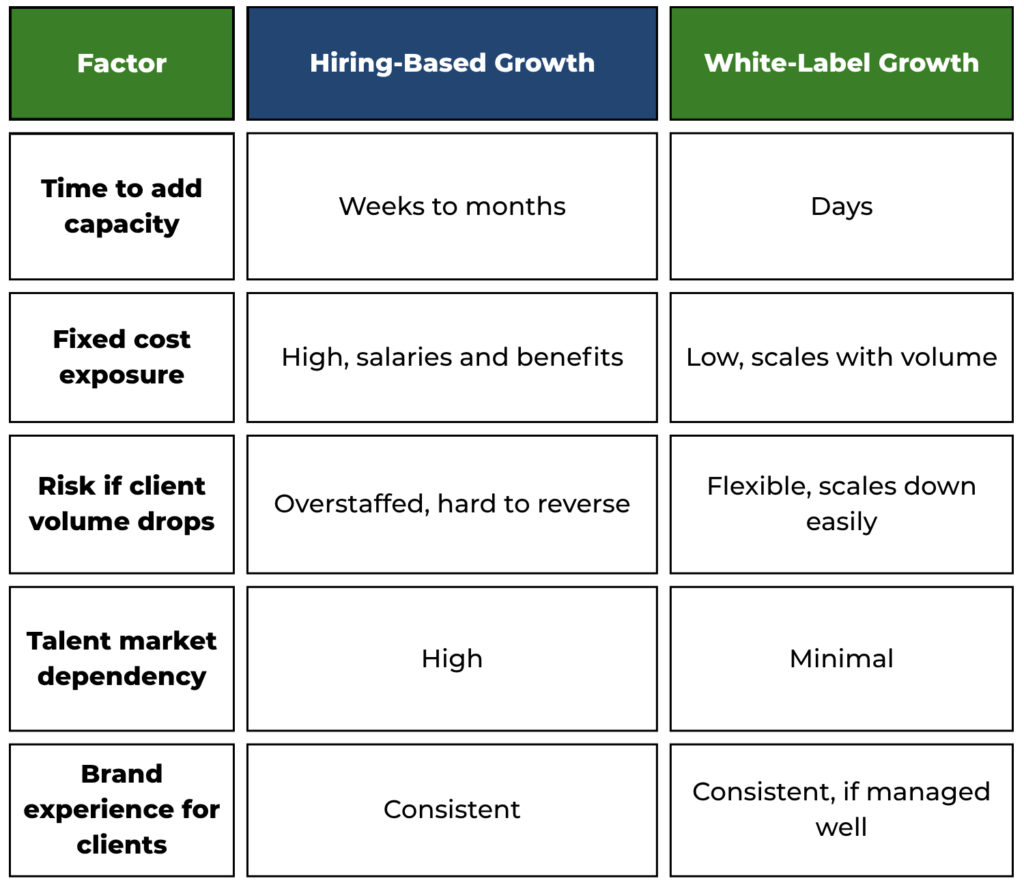
● The talent market hasn’t cooperated: Qualified bookkeepers and staff accountants are hard to find and harder to keep, making headcount-based growth slower and riskier than it used to be. Firms leaning on outsourcing for accounting firms sidestep that bottleneck entirely.
● Client demand doesn’t wait for hiring cycles: A firm can say yes to a new client the moment the opportunity appears, instead of waiting months to fill an open role first.
● Margins improve without new fixed costs: White-label partners are typically compensated per client or per engagement, which scales cleanly instead of adding permanent salary obligations.
● Brand equity stays intact: Clients see one consistent firm, one point of contact, and one trusted name, regardless of who’s actually producing the work behind it.
How the Model Works in Practice
A firm signs a new client needing bookkeeping and accounting services. Instead of assigning that work to an already-stretched in-house team, the firm routes it to a white-label partner that delivers accounting and financial statements under the firm’s branding and communication standards. The firm reviews and signs off, maintaining quality control, while the partner handles the production work behind the scenes, invisible to the client but fully accountable to the firm.
Traditional Growth vs. White-Label Growth
What Firms Need to Get Right
White-label accounting only works if quality stays consistent. Firms partnering with best outsourced accounting services providers need clear standards for turnaround time, formatting, and communication so the client experience never reveals the arrangement behind it. The firms that do this well treat the partner as an extension of their own team, not a vendor kept at arm’s length. That distinction usually separates a partnership that lasts years from one that quietly falls apart within a season.
Where This Fits Alongside Advisory Growth
White-label bookkeeping and tax prep free up in-house staff for the tax and advisory services work that actually differentiates a firm. Financial accounting advisory services and complex client strategy stay with the firm’s own team, while routine production work moves to the white-label partner. Instead of production capacity being the bottleneck on growth, the firm’s advisory bandwidth becomes the real lever, and that’s a far more scalable constraint to manage than headcount. Firms offering broader accounting services for business clients often find this the easiest place to start the shift.

The Bottom Line
Scaling a CPA firm no longer has to mean scaling payroll at the same pace. White-label accounting lets firms take on more clients, protect their margins, and sidestep a brutal hiring market, all while keeping the brand and the client relationship exactly where it belongs.
XACT.Inc offers white-label, cloud-based accounting and bookkeeping support built to help CPA firms grow without the hiring headache. Contact XACT.Inc today to see how white-label support could work for your firm.