
Month-end close can become one of the biggest operational bottlenecks for a growing CPA firm. As client volumes increase, accounting teams may spend days chasing missing invoices, reconciling accounts, reviewing transactions, and preparing financial statements.
The problem is rarely one difficult task. It is the accumulation of dozens of routine activities that must be completed before the books are ready for review.
That is where offshore accounting teams can add capacity. By moving defined production work to an offshore team, CPA firms can keep their internal professionals focused on review, client communication, and higher-value accounting and advisory services
Why Month-End Close Takes So Long
A typical close can involve bank and credit-card reconciliations, accounts payable and accounts receivable, journal entries, account reviews, supporting schedules, and financial reports in accounting.
When these tasks are handled entirely by a small internal team, delays can quickly compound.
Common bottlenecks include:
- Unreconciled bank and credit-card accounts
- Missing invoices and supporting documents
- Large transaction backlogs
- Delayed client responses
- Senior accountants handling routine production work
- Multiple clients reaching close at the same time
For firms providing bookkeeping and accounting services, these delays can affect both internal productivity and client delivery timelines.
How Offshore Accounting Teams Speed Up the Close

The biggest advantage of offshore accounting support is additional production capacity.
Instead of having senior accountants complete every transaction and reconciliation themselves, firms can delegate standardized work to an offshore team. This can include transaction categorization, reconciliations, accounts payable processing, supporting schedules, and preliminary financial reports.
The firm’s internal team then reviews completed work, resolves exceptions, and handles client-specific decisions.
This creates a clear separation between production and professional review.
What a 48-Hour Close Workflow Can Look Like
A 48-hour target depends on the firm’s data readiness, client responsiveness, transaction volume, and workflow design. It should therefore be treated as an operational target rather than a universal guarantee.
A structured workflow could look like this:
Day 1: The offshore team gathers available documents, processes transactions, completes reconciliations, and identifies missing information.
Day 2: Remaining production tasks are completed, exceptions are flagged, and draft financial reports are prepared for internal review.
The CPA firm’s professionals can then focus on reviewing exceptions, making adjustments, and communicating results to the client.
In-House vs. Offshore Close Support
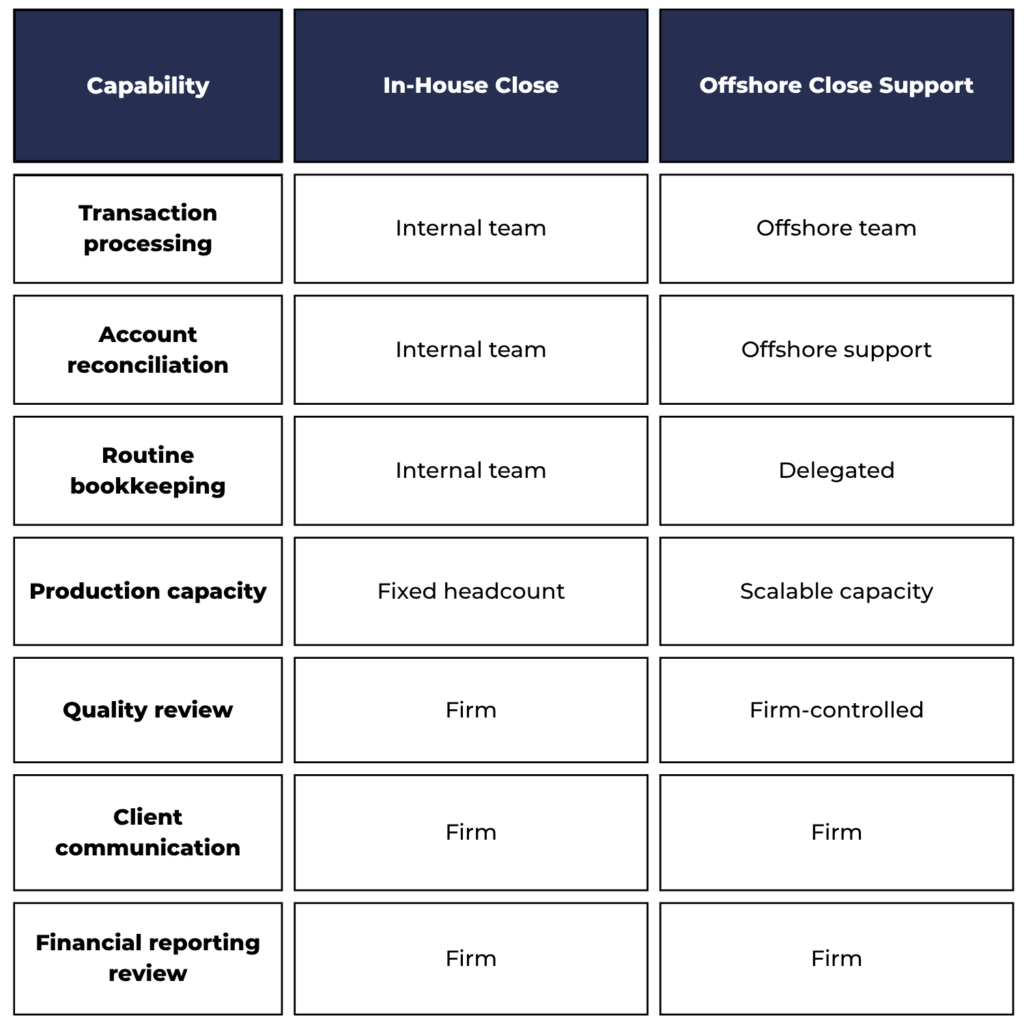
The model does not remove the CPA firm’s responsibility. Instead, it shifts repetitive production work away from senior professionals while keeping review and client ownership in-house.
What the CPA Firm Still Controls
Successful outsourcing for accounting firms depends on clearly defined responsibilities.
The CPA firm’s internal team can continue controlling:
- Client relationships
- Accounting policies
- Review procedures
- Adjusting entries
- Exception handling
- Financial statements
- Tax and advisory services

The offshore team works according to documented processes and escalation rules established by the firm.
Where This Model Creates the Most Value
Offshore close support can be particularly useful for firms managing multiple clients with similar monthly accounting requirements.
It can complement accountancy and bookkeeping services, accounting services for business, financial accounting advisory services, and broader outsourced accounting workflows.
The objective is not simply to close books faster. It is to create a repeatable process where growing client volume does not automatically create another hiring requirement.
The Bottom Line
A slow month-end close can consume valuable accounting capacity and delay financial reporting. A structured offshore accounting workflow can help firms process routine work faster while allowing internal professionals to concentrate on review, exceptions, and client-facing responsibilities.
A 48-hour close is achievable for some workflows when data is ready, responsibilities are clearly defined, and the process is properly managed.
XACT.Inc provides white-label offshore accounting and bookkeeping support that helps CPA firms increase production capacity without automatically increasing internal headcount.