
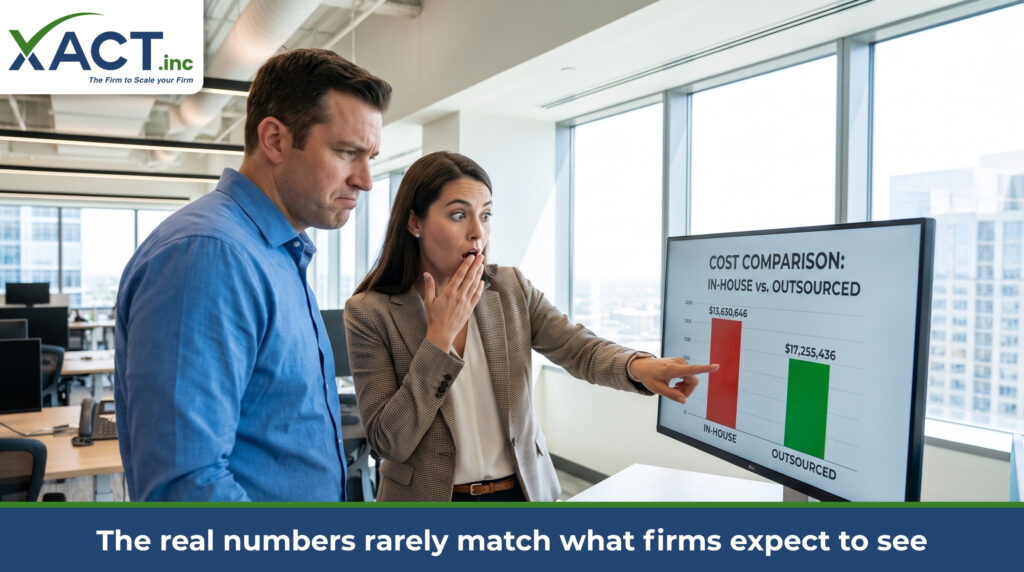
Ask a firm partner what in-house bookkeeping costs and most will quote a salary. That number is almost never the real total. The actual cost includes turnover, training, software, management time, and the opportunity cost of what senior staff aren’t doing while buried in reconciliation. Firms that only count the salary line are underestimating the true cost by a wide margin, and it’s quietly eating into margins every month without ever showing up as a line item anyone questions.
The Costs Nobody Puts on the Spreadsheet
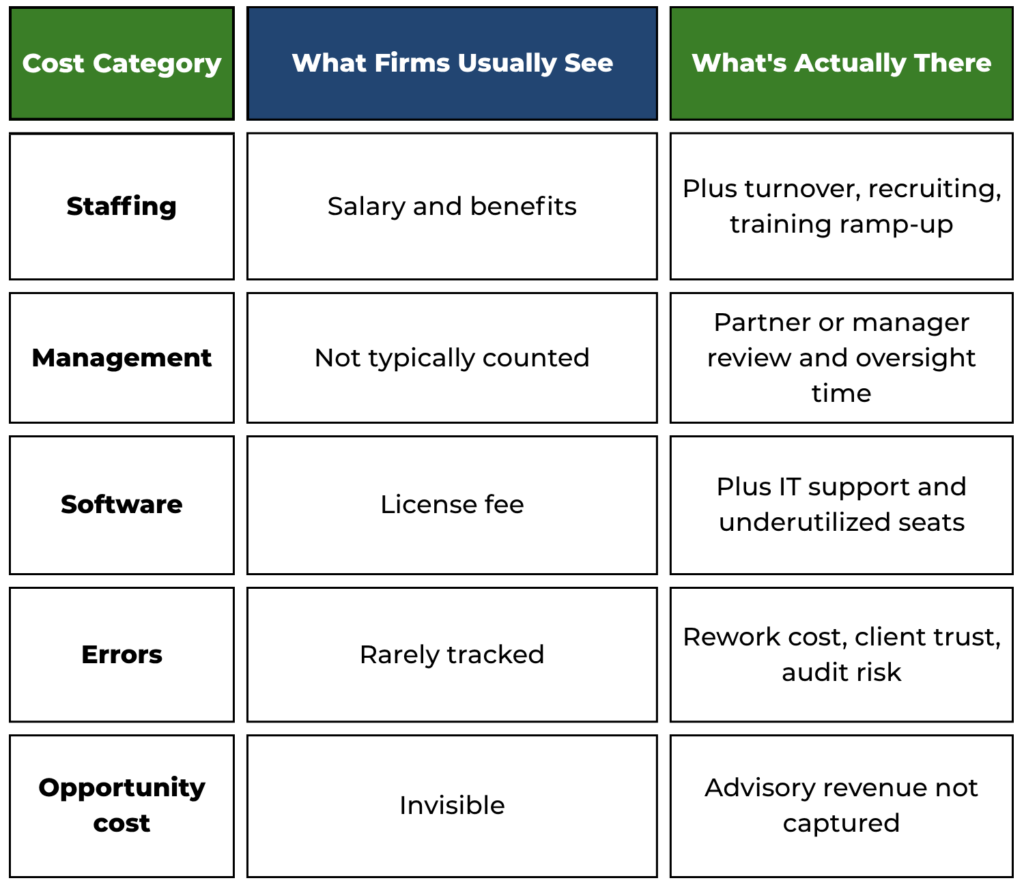
Salary and benefits are the visible cost. The hidden ones are what actually erode profitability over time.
● Turnover and rehiring. Every time a bookkeeper leaves, the firm eats recruiting costs, a training ramp-up period, and weeks of reduced productivity while the new hire gets up to speed.
● Management overhead. Someone has to supervise, review, and correct the work, which is time a partner or manager isn’t spending on client-facing or advisory work.
● Software and tooling costs. Licenses for bookkeeping software for business, plus the IT support to maintain them, add up whether or not the firm fully utilizes the tools.
● Error correction. Mistakes caught late, during tax season or an audit, cost far more to fix than they would have during routine reconciliation.
● Opportunity cost. Every hour spent on manual accounts payable accounts receivable work is an hour not spent on tax and advisory services that actually grow revenue.
Why This Cost Stays Hidden
Most firms track payroll closely but don’t track the downstream costs tied to it. Turnover, retraining, and error correction get absorbed into “the cost of doing business” instead of being measured against what an outsourced alternative would cost. That’s exactly why the comparison rarely gets made and why firms keep budgeting for in-house bookkeeping as if the salary line is the whole picture, year after year, without anyone stopping to add it all up.
Visible Cost vs. True Cost
What Outsourcing Actually Fixes
Outsourcing doesn’t just trade one cost for a lower one, it removes several hidden costs entirely. Firms partnering with best outsourced accounting services providers stop absorbing turnover risk, since the partner’s team doesn’t disappear when one employee leaves. This is part of why outsourcing for accounting firms has moved from a cost-cutting tactic to a core operating decision. Standardized processes reduce error rates, which means less costly rework later. And because the partner handles the routine bookkeeping and accounting services work, in-house staff get their time back for financial accounting advisory services that actually build client relationships and revenue.
How to Actually See the Real Number
Firms that want an honest comparison need to add up more than salary: recruiting costs from the last two years, average ramp-up time for new hires, hours partners spend reviewing junior work, and the client-facing hours lost to bookkeeping tasks. Clean accounting and financial statements should be the baseline outcome either way, not a bonus one path offers and the other doesn’t. That total, not the salary line alone, is the number that should be compared against an outsourced partner’s cost.

The Bottom Line
In-house bookkeeping isn’t free just because the invoice looks smaller than an outsourcing contract. The hidden costs, turnover, management time, errors, and lost advisory capacity, are real and they compound every year a firm doesn’t measure them. Firms that finally run the full comparison usually find the gap is bigger than they expected.
XACT.Inc helps CPA firms eliminate the hidden costs of in-house bookkeeping through an outsourced, cloud-based team built for consistency. Contact XACT.Inc today to see what the real cost comparison looks like for your firm.