Every business owner knows the feeling: you sit down to review your financials, and something does not add up. A bank balance that does not match your books. An expense that is miscategorized. A receivable written off incorrectly. Bookkeeping and accounting errors do not start as disasters. They start as small, recurring problems that compound quietly over months until they surface at the worst possible moment during a lender review, an accounting tax return filing, or an acquisition due diligence process. In 2026, the complexity of running a business has only increased. At XACT.INC, we see the same core challenges across industries. Here are the top bookkeeping and accounting for small business challenges businesses face today and how to solve them efficiently.
Reconciliation Errors That Distort Your Financial Accounting Reports
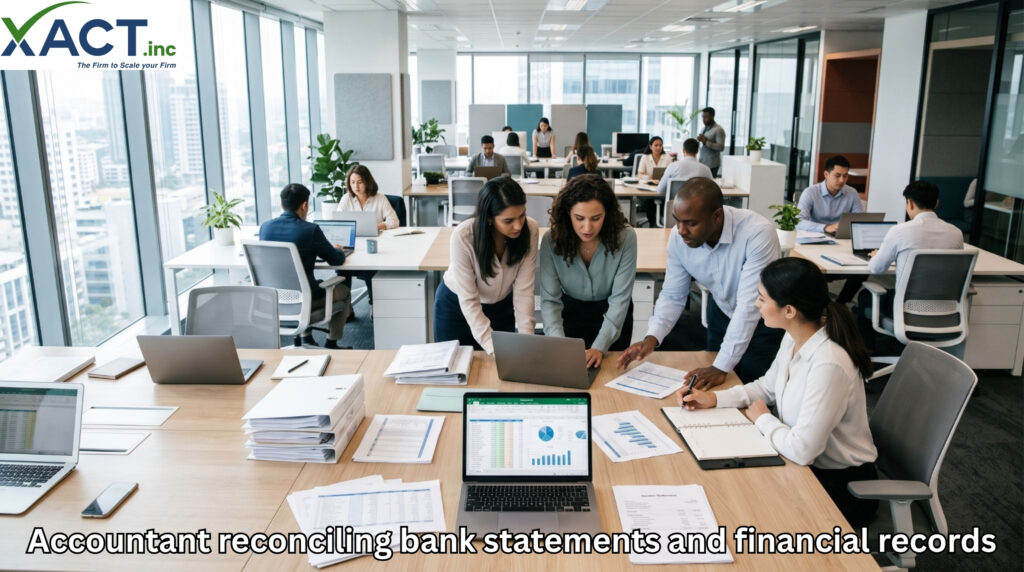
Reconciliation is the process of confirming that your accounting general ledger matches your actual bank and credit card activity. When done incorrectly or skipped entirely, your financial accounting reports become unreliable. Expenses get double-counted. Deposits get missed. The root cause is always the same: reconciliations are being done inconsistently, too infrequently, or by someone who does not have a firm grasp on the chart of accounts. The solution is to reconcile every account, including bank, credit card, loan, and payroll liability, monthly without exception. At XACT.INC, reconciliation is a non-negotiable step in our close process. Every account is tied out, every variance is investigated, and nothing moves forward until the ledger is clean.
Compliance Gaps in Accounting and Income Tax Obligations
Tax compliance in 2026 is not a one-time event. It is an ongoing obligation that touches accounting and income tax filings, payroll taxes, sales tax nexus determinations, 1099 filings, estimated quarterly payments, and state-specific reporting requirements. Compliance gaps do not just result in penalties. They compound, with interest gaining and notices escalating over time. To stay ahead of these risks, businesses should:
• Track payroll tax deposits in real time within your accounting and payroll services workflow
• Monitor sales tax thresholds by state, especially for businesses with remote employees
• Review contractor payments monthly to ensure 1099 obligations are found before year-end
• Build compliance checkpoints directly into the bookkeeping workflow, not as an afterthought
• Work with accounting and tax specialists who proactively flag exposure before filing deadlines
Cash Flow Visibility: The Accounting Cash Flow Statement Problem
Profitability and cash flow are not the same thing, and the distinction matters enormously. A business can show a healthy net income on its profit and loss statement while simultaneously running out of cash if receivables are slow, inventory is over-purchased, or loan principal payments are not reflected correctly. When business owners cannot answer how much cash they will have in 30 days with any confidence, financial planning becomes guesswork. The solution is to keep a rolling accounting cash flow statement updated at least weekly. This requires your books to be current and your bookkeeper to understand the difference between accrual and cash basis reporting. XACT. INC delivers updated cash position reports as part of our standard monthly close package.

Expense Misclassification and Its Impact on Financial Accounting Analysis
Misclassified expenses do not just create messy reports. They inflate certain cost categories, deflate others, and generate deduction errors that cost real money at tax time. Common misclassifications include personal expenses coded as business meals, capital expenditures expensed rather than capitalized, and loan proceeds recorded as revenue. These errors directly compromise the quality of your financial accounting analysis. The solution is to prove clear expense categorization policies, use a well-structured chart of accounts proper to your industry, and conduct a monthly review of large or unusual transactions before closing. Our team at XACT.INC flags any transaction that deviates from a client’s established patterns before it creates downstream issues.
Lack of Expert Oversight in Bookkeeping and Accounting for Small Business
The single most pervasive bookkeeping challenge in 2026 is a people problem. Many businesses rely on a single, under-resourced bookkeeper or a non-accountant to manage their entire financial record. Without a trained eye reviewing the work, errors accumulate undetected. Every bookkeeping function needs expert oversight: a senior accountant reviewing the ledger before reports are issued, a formal close process with documented steps, and a second set of eyes on anything that does not look right. This is the standard XACT. INC applies to every client engagement, regardless of business size.

Conclusion
The bookkeeping and accounting challenges businesses face in 2026 are predictable, preventable, and solvable, but only with the right systems and the right ability. Reconciliation discipline, proactive accounting and taxation compliance management, real-time cash visibility, and expert oversight are not optional upgrades. They are the baseline standard for any business serious about its financial health. At XACT.INC, we do not just record transactions. We build the financial foundation your business needs to grow with confidence. If any of these challenges sound familiar, the time to address them is now, not at year-end.