Crypto tax reporting is becoming a bigger production challenge for CPA firms. Form 1099-DA is now part of the reporting process for digital asset transactions, and 2026 brings another important step: brokers must report basis information for certain covered digital assets.
For firms handling clients with cryptocurrency, stablecoins, NFTs, and other digital assets, the additional reporting requirements can create more data, more reconciliation work, and more review during tax season.
That is where outsourced tax prep can provide additional production capacity without requiring CPA firms to build a larger seasonal team
What Is Form 1099-DA?
Form 1099-DA, Digital Asset Proceeds From Broker Transactions, it is used by brokers to report digital asset proceeds and, in certain cases, basis information to taxpayers and the IRS.
The reporting rules are being phased in. Brokers generally report gross proceeds for transactions occurring on or after January 1, 2025. For certain covered digital assets, basis reporting applies to transactions occurring on or after January 1, 2026.
This means CPA firms may encounter more detailed digital asset information during the 2026 tax season.
Why 2026 Creates More Work for CPA Firms
Crypto tax preparation already requires accountants to work with transaction histories, cost basis, proceeds, holding periods, and supporting documentation.
Additional broker reporting can create another layer of information that needs to be reviewed and reconciled with the client’s tax records.
Common challenges include:
- Large volumes of digital asset transactions
- Multiple wallets and exchanges
- Different transaction types
- Basis information requiring review
- Missing or inconsistent records
- Additional reconciliation and workpaper preparation
For firms providing tax and advisory services, this can add substantial production work during an already busy filing season.

How Outsourced Tax Prep Handles the Additional Work
Outsourced tax preparation allows CPA firms to move defined production activities to an external accounting team while retaining professional review and client responsibility internally.
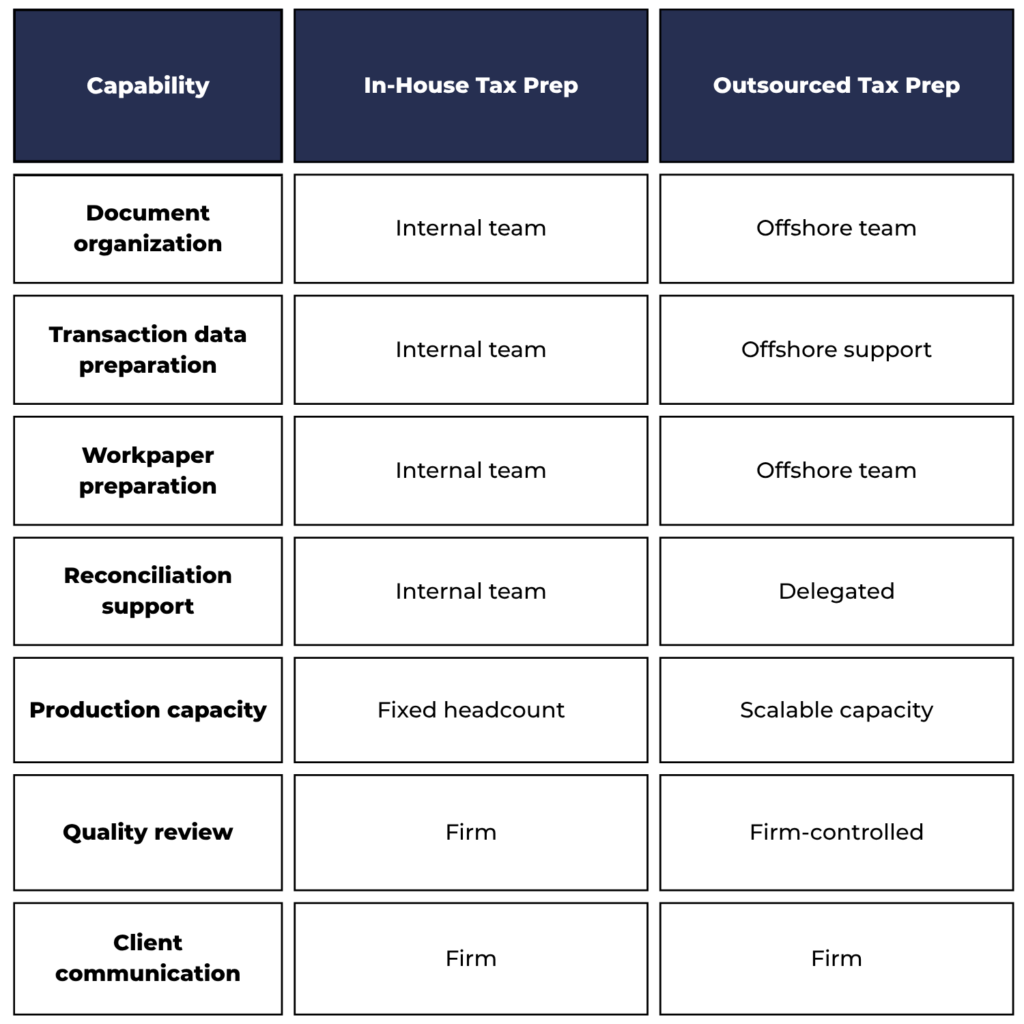
An offshore tax team can support activities such as document organisation, transaction data preparation, workpaper preparation, reconciliation support, and preliminary return preparation.
The CPA firm can then focus on tax positions, exceptions, complex decisions, quality control, and client communication.
This creates a clear separation between production work and professional review.
1099-DA Workload: In-House vs. Outsourced
Managing Crypto Reporting at Scale
The challenge becomes more significant when a CPA firm serves multiple clients with digital asset activity.
One client may have transactions from several exchanges. Another may have multiple wallets, transfers, or different types of digital assets. The production workload can quickly become difficult to manage during peak tax season.
An outsourced tax team can help organise and process standardised work before it reaches the CPA’s final review.
The goal is not to outsource professional judgement. It is to move repetitive preparation work away from experienced tax professionals so they can spend more time on decisions that require their expertise.
What the CPA Firm Still Controls
Outsourcing does not remove the CPA firm’s responsibility for the tax return.
The internal team can continue controlling:
- Tax positions
- Complex digital asset issues
- Final return review
- Quality standards
- Client communication
- Exception handling
- Tax and advisory services
The outsourced team works according to the firm’s procedures, documentation standards, and review requirements

Why This Matters During Tax Season
The IRS says taxpayers must report income, gains, and losses from digital asset transactions even when they do not receive a Form 1099-DA.
That means CPA firms cannot treat broker statements as the entire tax picture. The statements are another important source of information that needs to be incorporated into the broader tax preparation process.
For firms expecting more crypto-related reporting work, building additional production capacity before the workload peaks can help prevent experienced tax professionals from becoming bottlenecks.
The Bottom Line
Form 1099-DA is becoming an increasingly important part of digital asset tax reporting, with 2026 bringing mandatory basis reporting for certain covered digital assets.
For CPA firms, the bigger challenge is managing the additional data and preparation workload without allowing crypto reporting to slow down the rest of tax season.
Outsourced tax prep can provide scalable production support for document organisation, workpapers, reconciliation, and return preparation while the CPA firm keeps professional judgement, quality control, and client relationships in-house.
XACT.Inc provides white-label offshore tax preparation and accounting support that helps CPA firms increase seasonal capacity without automatically increasing internal headcount.