

Most partners hear “cut your bookkeeping costs in half” and assume it means cutting corners. It doesn’t have to. The firms hitting 30-50% savings aren’t skimping on review or rushing client work. They’re changing where that work gets done and how it’s staffed, not doing less of it.
The Range Isn’t Random
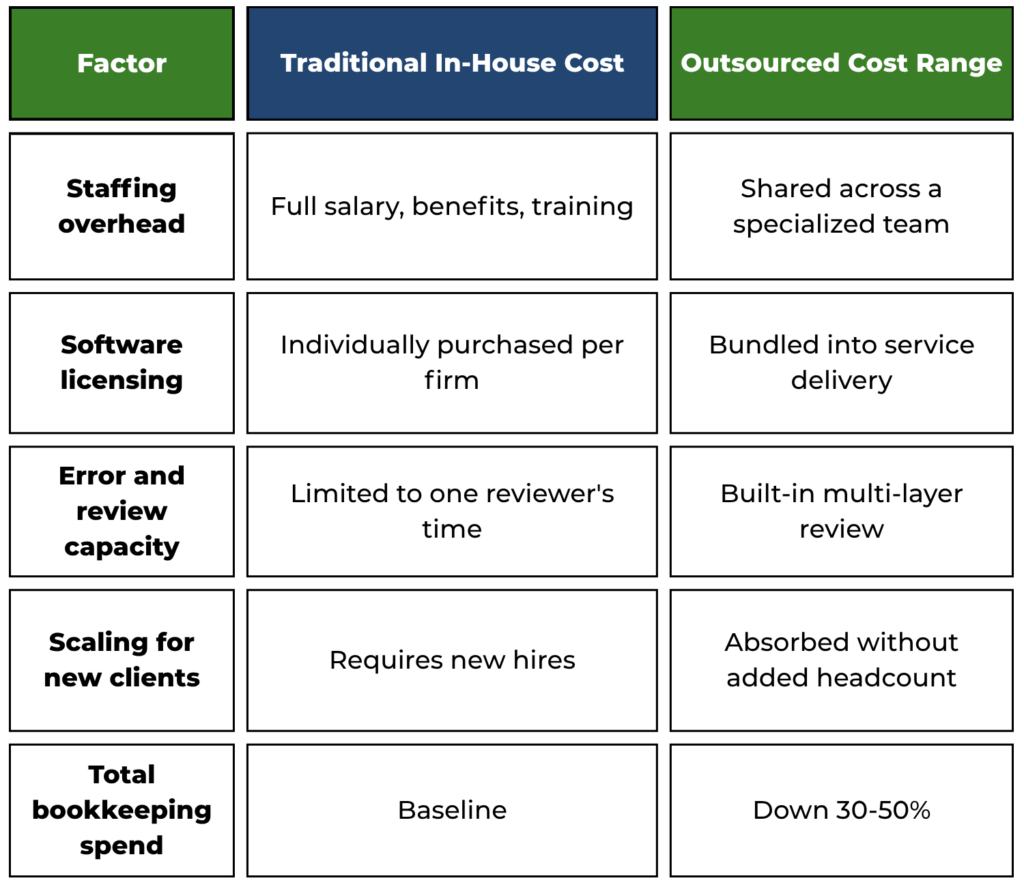
The 30-50% savings range shows up so consistently because it reflects real, measurable overhead: salaries, benefits, office space, software licenses, training, and management time for an in-house bookkeeping function. None of that overhead affects how accurate the numbers are. Best outsourced accounting services providers spread that same infrastructure across many clients instead of one firm carrying it alone, which is where the savings come from.
Where Firms Land in That Range
Not every firm hits 50%. The variance depends on a few factors:
● Firm size and transaction volume: Larger firms with repetitive transaction types tend to see savings closer to the higher end of the range.
● Current staffing structure: Firms replacing multiple part-time or overworked staff typically save more than firms replacing one efficient hire.
● Scope of work outsourced: Firms that outsource the full bookkeeping and accounting services function see bigger savings than firms that only outsource pieces of it.
● Software and tooling overlap: Firms already paying for redundant bookkeeping software for business often recover part of that spend immediately.
● Existing accounting services for business infrastructure: Firms with cloud-ready systems already in place tend to transition faster and see savings sooner.
Cost Savings Without the Quality Trade-Off
Why Quality Often Improves, Not Just Cost
Outsourced teams built around modern accounting and financial statements workflows bring standardized processes and AI-assisted checks that catch errors a single overworked employee might miss. Firms partnering with financial accounting advisory services providers frequently report several concrete quality gains after the switch:
● Fewer reconciliation errors: since the work runs through a built-in review layer instead of one pass.
● Faster monthly close: because the team isn’t juggling bookkeeping alongside unrelated tasks.
● More consistent categorisation: since standardized processes replace individual shortcuts.
● Better continuity: since the work doesn’t stall when one employee is out or leaves the firm.
None of this happens because the outsourced team works harder. It happens because the delivery model removes the single points of failure that come with one in-house hire.
Where the Savings Actually Go
The savings rarely just sit as extra margin. Firms typically redirect the freed-up budget in a few consistent directions:
● Advisory expansion. Reinvesting in tax and advisory services, the higher-value work that actually differentiates a firm from competitors still stuck doing routine compliance.
● Client growth without new hires. Using the freed-up capacity to take on new clients without expanding headcount, which compounds the original savings even further over time.
● Technology upgrades. Redirecting part of the savings into better client-facing tools and reporting dashboards that improve the overall client experience.
● Staff retention. Reducing burnout among existing staff by taking routine bookkeeping off their plate, which lowers costly turnover.
Firms leaning into outsourcing for accounting firms as a core strategy, not a one-time fix, tend to see the benefit grow year over year rather than plateau.

The Bottom Line
A 30-50% reduction in bookkeeping costs is achievable without touching accuracy or client service, but only when the savings come from a smarter delivery model rather than a discount vendor. Firms chasing the cheapest option alone usually sacrifice something. Firms restructuring how the work gets done don’t have to.
XACT.Inc helps CPA firms capture real bookkeeping savings through an outsourced, cloud-based team built for consistency and scale. Contact XACT.Inc today to see where your firm could land in that 30-50% range.